As we approach the end of the year, the
industry naturally turns its gaze to the next twelve months. But
looking at the data emerging for 2026, we’re seeing something more
substantial than the usual seasonal trends. We are witnessing the dawn
of a new computing era.
The conversation is moving away from
cloud dependency toward the "AI PC"—moving artificial
intelligence processing directly onto the device via Neural Processing
Units (NPUs). It’s a technological marvel, certainly. But for those of
us in the retail and channel space, the implications are less about
the silicon and more about how this shifts the economics of the shop floor.

Here is what we are watching closely
as these changes take hold.
The Price of Progress
One of the first things we’ve noted
is the economic friction this transition creates. As AI
infrastructure creates component shortages costs are increasing,
with laptop prices potentially rising by 5% to 15%.
This creates an interesting dilemma.
We are likely to see a distinct split in the market. On one side, the
premium buyer who wants the latest performance. On the other, the
budget-conscious consumer who may find themselves priced out of new
hardware, turning instead to the used-device market or delaying
upgrades entirely.
For retailers, this suggests that
financing tools like 'Buy Now, Pay Later' are about to become much
more than a value-add; they may become the primary vehicle for keeping
the latest technology accessible.
Privacy as the Conversation Starter
For years, privacy has been a
background spec. In 2026, it looks set to become more the headline.
With the vulnerabilities of
cloud-based AI making consumers increasingly nervous, the AI PC offers
a refreshing narrative. Because NPUs handle sensitive tasks on the
device itself, personal data doesn't need to leave the laptop.
We suspect there is a strong
opportunity here for floor staff. It allows them to pivot the sales
conversation from "how fast is it?" to "how safe is
it?". Privacy is no longer just a feature; for many, it will be
the primary reason to upgrade.
The Knowledge Gap: ARM vs. x86
The landscape is also becoming more
fragmented. We are seeing a migration towards ARM-based architectures,
favoured for their battery life and mobile efficiency.
This architectural divergence brings
a practical challenge: staff training. A consumer walking in 2026
will have to choose between x86 and ARM platforms, each with
distinct pros and cons. Retailers may want to ensure sales staff are
equipped to guide customers through that choice with clarity.
Selling a Lifestyle, Not a Spec Sheet
Perhaps the most profound shift is
that the laptop is ceasing to be a standalone purchase. It is becoming
the hub of a personal ecosystem.
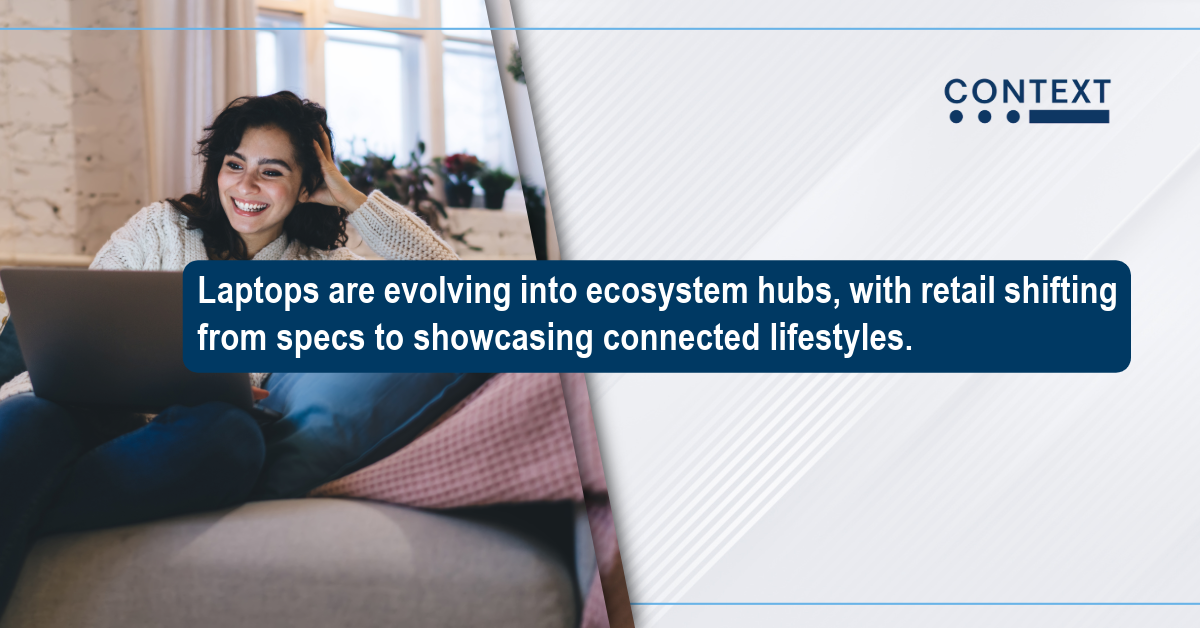
Consumers are increasingly looking
for systems that seamlessly link their mobile, smart home devices,
and wearables. They aren't buying a processor; they are buying
time-saving automation and health monitoring.
This potentially changes the visual
merchandising game. It moves the goal from stacking boxes to creating
spaces where these integrated systems can be seen in action—selling a
connected lifestyle rather than a list of specifications.
The Longevity Expectation
Finally, we cannot ignore the
"Value-Driven Consumer". There is a growing rejection of
disposable hardware. Loyalty is shifting toward brands that embrace a
"Design for Longevity" ethos—high repairability, replaceable
parts, and longer software support.
The challenge for the industry in
2026 will be balancing the excitement of new AI features with this
demand for sustainable, lasting value.
Navigating the Year Ahead
2026 promises to be a year where the
definition of personal computing expands. It’s a landscape of new
price points, new architectures, and a more demanding, value-conscious consumer.
At CONTEXT, we spend our time
tracking these shifts at a granular level through our
TotalMarket data, helping the industry make sense of the noise.
It is going to be a complex year,
but a fascinating one.
Interested in keeping
a pulse on these changes? We share insights like this,
along with specific market movements, in our weekly newsletter.
Sign up for the CONTEXT
Retail Pulse Newsletter now.