March 2026 was not an ordinary month. It
delivered a landmark milestone, a memory market in freefall, and a
structural signal that the AI revolution has decisively moved from
software into silicon. For anyone operating in the IT channel, the
dynamics that played out this month will define commercial strategy
well into the second half of the year.

A Milestone Five Years in the Making
This month marked the 300th edition
of the Weekly IT Industry Forum, a series that began in the first
lockdown of 2020, born of necessity and sustained by relevance. What
started as a stopgap for a grounded industry has become a benchmark
for channel intelligence across Europe and beyond. The journey from
that first remote session to the 300th is, in miniature, the story of
how the IT industry has adapted: faster, more distributed, and more
analytically rigorous than it has ever been.
MWC 2026: AI Is No Longer a Product, It’s an Architecture
Mobile World Congress in Barcelona
set the tone for the year. The dominant takeaway was not a device or
a platform; it was a principle. AI has matured beyond a collection
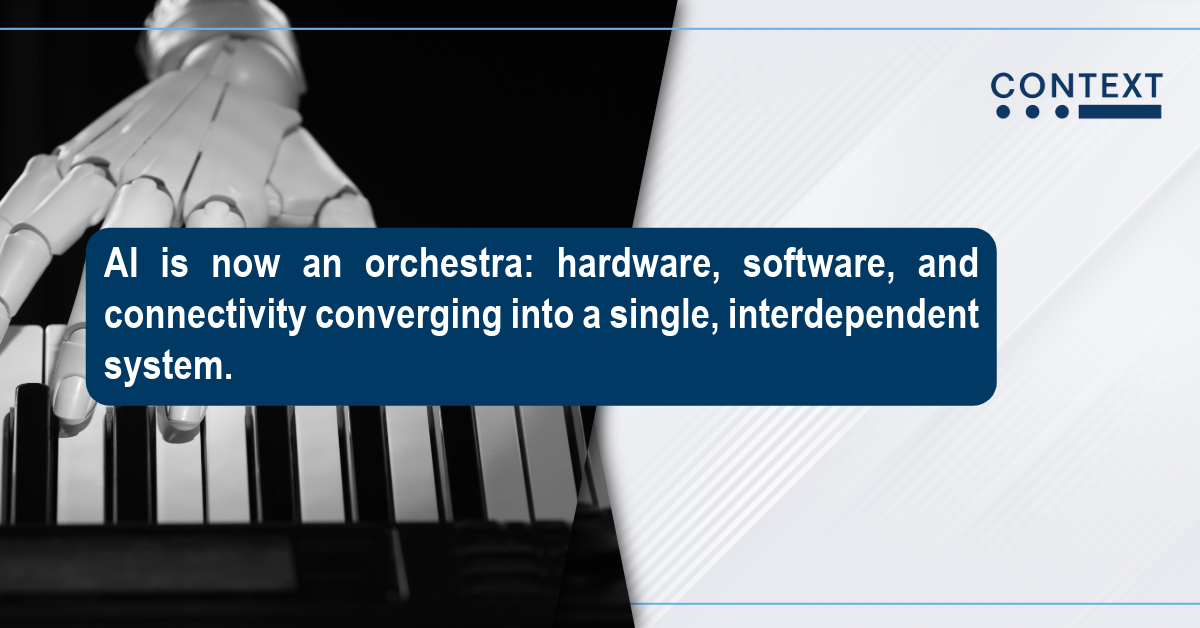
of discrete applications. It is now an orchestra: hardware,
software, and connectivity converging into a single, interdependent
system where each layer must perform for the whole to function.
The implications for the channel
are structural. Software’s recent leapfrog has exposed a critical
gap in physical infrastructure. Energy-efficient processing and
high-capacity storage are no longer “nice to have” capabilities;
they are load-bearing pillars of the AI stack. Hardware is back at
the centre of the conversation, and procurement cycles are adjusting accordingly.
The Memory Crisis: From Shortage to Panic
If MWC set the strategic context,
the memory market provided the month’s most visceral commercial
reality. The sustained pressure of AI-driven demand has produced
pricing dynamics that are now crossing the threshold from disruptive
to destabilising.
The headline numbers tell the story plainly:
- Micron’s blowout quarter: Revenue nearly
tripled year-on-year, reaching just under $24 billion, a figure
that reflects not an anomaly but a structural shift in where
technology investment is flowing.
- RAM prices
in freefall: In several European markets, RAM prices have
quadrupled over six months. The word “volatile” understates what
buyers are now navigating.
- The distributor buffer
is draining: Distributors have been absorbing the shock by
selling inventory purchased at 2025 prices. That insulation is
running out. Old-cost stock is expected to be exhausted by
summer, and the period that follows (particularly in markets
like France) will be defined by panic buying as resellers race
to lock in supply before spot-market prices bite.
For channel players, the message is
unambiguous: procurement decisions delayed are margin points surrendered.
Infrastructure: The Two-Phase Build-Out
The enterprise sector is moving
through a sequenced infrastructure expansion, and understanding where
each market sits in that sequence is now a competitive differentiator.
01 COMPUTE FIRST
Germany and the UK are deep in the
first phase, with double-digit server revenue growth. The UK is
performing notably above its typical Q1 seasonal baseline, a signal of
structural demand rather than calendar rhythm.
02 STORAGE SECOND
Poland and Spain are entering the
follow-on phase, with legacy refresh cycles commencing. This is where
the next wave of significant volume will materialise.
03 THE SSD / HDD SPLIT
NAND shortages are pushing SSD
prices upward, while high-capacity HDDs (essential for storing the
cold data that trains Large Language Models) are already booked out
for the remainder of 2026. Vendors who secured long-term HDD
commitments early are sitting on a significant commercial advantage.
Regional Spotlights: Five Markets to Watch
The macro picture is complex, but
the regional texture is where the actionable intelligence lies.
- Spain: Next Generation EU funds remain a
powerful demand driver, with a hard execution deadline of 31
August 2026 keeping the business channel under productive
pressure. The clock is an accelerant.
- The
Nordics: Software continues to outperform, with the region
leading Europe in recent weeks. A bellwether for where the rest
of the continent is heading.
- Brazil:
Positioning as a global hub for sustainable AI data centres.
A long-term play, but one gaining credibility with each
infrastructure announcement.
- Argentina:
Entering a normalisation cycle following a recovery year in
2025. A market demanding precision and patience in equal
measure.
- UK: Consumer confidence remains
depressed, dragged by cost-of-living pressures and an unusually
wet start to the year that reduced retail footfall. The
enterprise and SMB channels tell a different, more constructive
story.
Cybersecurity: The Talent Gap Is the Market
Cybersecurity remains a
non-negotiable line item in every deal. Volume at the start of 2026
felt slightly softer than the prior year’s pace, but the structural
story is one of accelerating demand expressed through a different channel.
In Germany, MSP growth hit 72% this
quarter. Firms are not choosing to outsource security operations out
of preference; they are doing so because the alternative, hiring
in-house, is no longer viable. A 75% talent gap in the cybersecurity
workforce, combined with strict new regulatory reporting deadlines,
has made MSPs the path of least resistance for compliance. That
dynamic is not reversing. It is intensifying.
Looking Into Q2: Complexity Is the Forecast
Q1 has outperformed expectations in
several regions, but the second half of 2026 remains genuinely
difficult to model. Geopolitical tensions in the Middle East continue
to affect shipping routes and energy costs, and the memory market’s
trajectory will depend heavily on whether supply catches up with
AI-driven demand or whether the panic-buying cycle entrenches higher
price floors.
The competitive landscape is being
redrawn in real time. The vendors who move with analytical precision,
reading the phase each market is in, securing supply ahead of the
curve, and positioning MSP and security capabilities as strategic
assets rather than add-ons, will find Q2 considerably more rewarding
than those who are still reacting to March.
For more on
these and other IT channel trends, tune into CONTEXT’s
weekly IT Industry Forum webinars. Register here.