February 2026 proved to be a month that
demanded close attention. Session after session, one topic
consistently rose to the top of the agenda: a component supply
challenge that is now very much a reality, with tangible implications
for channel businesses.
Here is what stood out across the month.
The Component Crisis: From Background Noise to Defining Story
If there was one story threading its
way through every session this month, it was the accelerating shortage
of RAM and SSDs, and the price consequences that are following hard
behind it.
The root cause is not mysterious.
The appetite of hyperscale data centres for high-bandwidth memory is
consuming the vast majority of global silicon production.
High-bandwidth chips reportedly need three times as much silicon as
standard memory, which means that every server rack spinning up to run
an AI workload is effectively crowding out supply for everything else.
One industry veteran with four decades of experience described the
current supply-demand mismatch as the most unprecedented he had ever
seen. That is not a small claim.
The numbers back this up. Our
pricing index, built on a mid-2025 baseline before the worst of the
disruption hit, shows RAM prices rising sharply from around last
summer, with the most dramatic jumps in the final quarter of the
year. SSDs have followed a similar path. In January's distribution
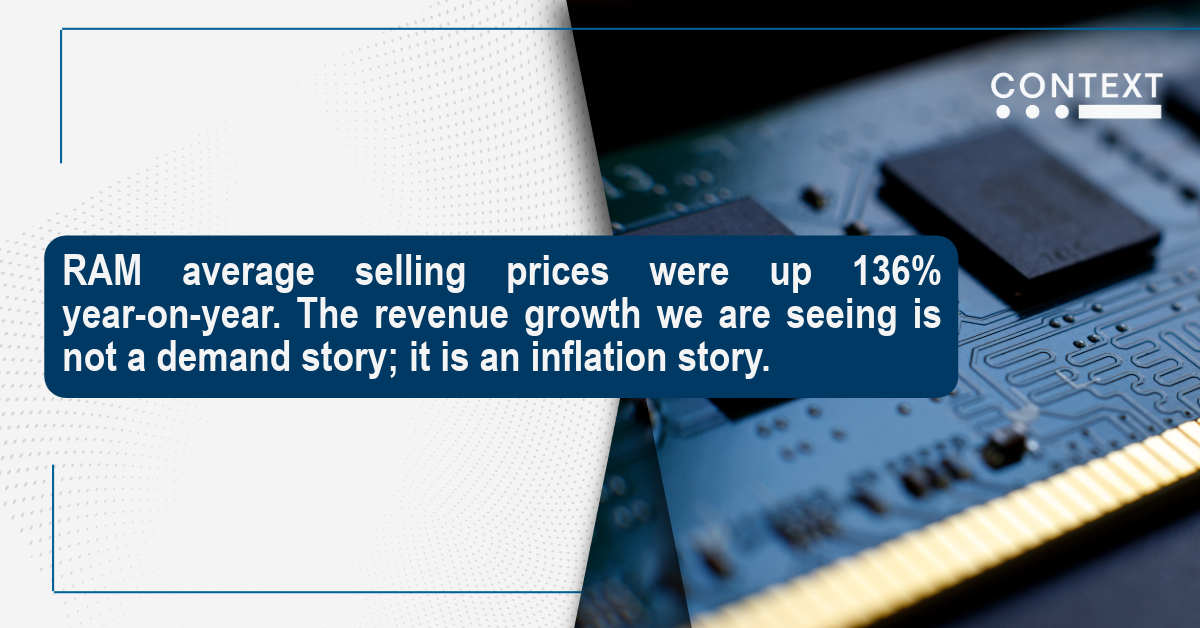
data, RAM average selling prices were up 136% year-on-year.
Meanwhile, unit volumes across most hardware categories were
actually falling. So the revenue growth we are seeing in the indices
is not a demand story. It is an inflation story, and that
distinction matters.
Western Digital and Seagate
confirmed the picture further by announcing that their entire
planned production for 2026 has already been pre-sold, absorbed by
the hyperscalers before a single unit has shipped. With production
unable to scale quickly, most in the room expect this to run well
into 2027.
How the Channel Is Responding
The supply squeeze is already
changing behaviour. The most visible shift is a wave of order
pull-in, with resellers stocking up early to secure inventory at
today's prices before the next round of increases lands. It is
flattering short-term revenue numbers, but it is also masking what
may be genuine underlying softness in demand.
Pricing quotes are becoming a
particular headache. Where 30-day price commitments were once
standard, many are now being issued for a fortnight, sometimes less.
Some vendors have begun introducing terms that allow repricing or
cancellation if costs move before delivery. For a corporate buyer who
already has budget sign-off for a project, being told mid-process that
the price has changed is more than inconvenient. It is a governance problem.
Buyers are starting to look for ways
around the problem. Cloud, device-as-a-service and deferred rollouts
are all being considered. There is also a genuine opportunity opening
up for the refurbished device market. With new hardware scarce and
expensive, used devices with third-party warranties are starting to
look like a sensible business decision rather than a compromise, which
is also good news for ESG commitments around extending device lifespans.
ISE Barcelona: AI Takes Centre Stage
February also brought ISE in
Barcelona, the world's leading event for the AV and systems
integration industry. This year attracted 93,000 visitors, up 8% on
last year, across 101,000 square metres of show floor. The event is
clearly still growing.
The most striking thing was what was
missing. After two years of sustainability-heavy messaging, the ESG
narrative had largely disappeared from the stands, replaced by AI
integration at almost every turn. Smart boardroom screens that compile
meeting notes, interactive displays repurposed from education into
commercial settings, hardware products with AI software baked in as a
selling point rather than a feature. The industry's focus has shifted,
and it has shifted fast.
Asian vendors were notably more
visible than in previous years, and their presence is putting real
pressure on average selling prices. ePaper solutions also drew
interest, though the consensus was that it needs considerably more
time before it sees any meaningful market traction. Deeper coverage
from our analysts at the event is expected over the coming weeks.
Enterprise Networking: Wi-Fi 8 Already on the Horizon
Much of the channel is still rolling
out Wi-Fi 7, but this month Broadcom announced the first
enterprise-grade Wi-Fi 8 solution, a unified access point and
switching product positioned specifically for AI-ready environments.
MediaTek had made noise at CES, but that was consumer-focused. The
Broadcom announcement is the first with real enterprise credentials,
and it signals where the market is heading sooner than many expected.
The HPE-Juniper integration also
came into focus, with the Winter Olympics providing a public proof
point. The combined network used Juniper's Marvis assistant
alongside HP's Aruba Central platform, with generative AI enabling
the network to manage and troubleshoot itself rather than simply
report problems upward. Whether or not you follow Olympic sport,
that is worth paying attention to.
Regional Spotlights: From the Baltics to EMEA
The Baltic states were a genuine
highlight this month. After a strong 2025 that closed with 26%
year-on-year growth in Q4, the region is set to benefit from a record
influx of EU funding worth 2.8 billion euros, with a substantial
portion earmarked for defence infrastructure. For distributor partners
in the region, that is a meaningful pipeline. Estonia also
outperformed its own forecasts, driven by private demand and wages
growth, with a survey showing 42% of Estonians expecting their
financial situation to improve this year.
Across the wider European picture,
January held up well. Spain is performing strongly, supported by
corporate and defence-related project spend. Poland remains a reliable
growth market, partly on the back of education sector activity. Italy,
however, continues to struggle. There is no single big deal driving
things there and demand remains soft. Germany is an interesting case:
the indices look strong, but anecdotal feedback from system
integrators suggests that fast-moving prices are making it very hard
to hold a project together from quote to delivery.
Workstations were a bright spot at
the EMEA level, with both desktop and notebook segments growing in
double digits in Q4 2025. Demand for high-performance computing,
driven at least in part by AI workloads, is clearly contributing.
The Bigger Picture: Does AI Productivity Live Up to the Hype?
One moment from the final week
deserves a mention on its own. A recent assessment of AI's actual
productivity impact in the US found, in short, almost none at an
organisational level. AI is useful for individuals. The jump to
enterprise-wide productivity gains requires a depth of organisational
change that takes years to achieve, not a software rollout.
It is worth sitting with that for a
moment. The supply crisis gripping the channel right now is being
driven, more than anything else, by AI infrastructure investment. Yet
the returns on that investment may arrive considerably later than the
market is currently pricing in. As one contributor put it, nothing
kills high prices quite like high prices. Buyers will find
workarounds, defer decisions, or simply wait. The market has a way of
correcting itself.
Looking Ahead
March is unlikely to be quieter.
Component pricing will keep evolving and the tension between rising
prices and actual volume demand will be one of the more interesting
things to watch. The PC accessories market is picking up following the
refresh cycle, workstations remain solid, and the regional picture has
enough variation to keep things interesting.
The channel has always been good at
finding its footing in uncertain conditions. How it handles this
particular combination of factors will be worth watching closely.
For more on
these and other IT channel trends, tune into CONTEXT’s
weekly IT Industry Forum webinars. Register
here.